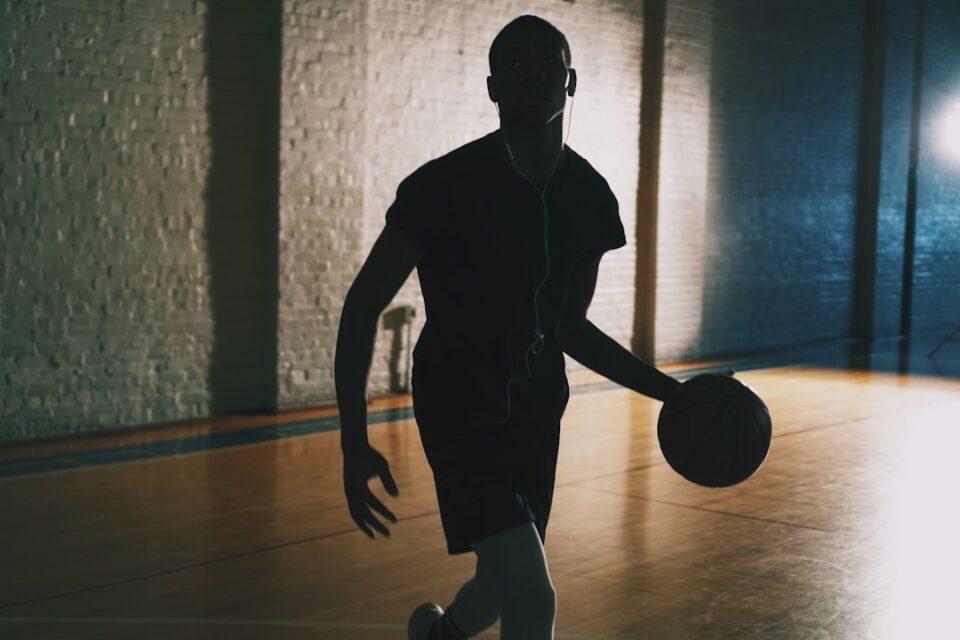
basketball shooting form can look simple from the stands and still feel messy when the ball leaves your hand. One shot feels clean. The next one drifts left. Then the follow-through gets rushed, the feet stop working, and the whole motion turns into guesswork. The goal of this guide is not to give you a pretty-looking jumper. The goal is to help you build a motion that you can repeat when you are tired, defended, and thinking about the next possession instead of the last miss.
I have watched a lot of players chase the wrong thing. They copy a pro’s hand finish, change their elbow angle three times in one week, and wonder why nothing sticks. Real improvement usually starts with a simpler idea. Good shooting is a chain. If one link is weak, the shot still goes in sometimes, but it does not travel the same way twice. That is the problem most players feel, even if they cannot name it yet.
This article breaks the shot down into pieces that you can actually work on. Feet. Balance. Ball path. Release. Repetition. Maintenance. Not because the game is academic, but because your shot gets better when the parts stop fighting each other. If you want more basketball fundamentals beyond this guide, you can always explore All Free Sports for more training ideas and basketball content.
basketball shooting form checkpoints that matter most
When people talk about basketball shooting form, they often jump straight to the finish. That is the visible part, so it gets all the attention. But the finish is only the last frame of a longer motion. If the base is unstable, the ball still has to solve a bad problem on the way up. If the shot pocket is too low, the release has to work harder. If the timing between legs and arms is off, the ball floats or gets pushed instead of lifted.
The easiest way to think about form is to ask one question after every rep. Did the shot feel like one connected motion, or did it feel like separate parts trying to agree with each other? A connected shot usually has a balanced base, a clean lift, and a release that happens because the body is already moving upward. A disconnected shot often looks fine in one frozen frame but breaks down in motion.
That is why simple checkpoints matter more than complicated theories. I like to watch for five things. Are the feet set with enough stability to absorb and redirect force? Does the ball arrive in the same pocket every time? Does the shooting elbow stay under the ball without being forced? Does the release finish with a relaxed wrist and fingers pointed toward the rim? Does the landing stay controlled, or does the body drift and twist?
None of these checkpoints is magical by itself. A player can do four of them well and still miss. But if the same two mistakes show up over and over, the shot starts to reveal its pattern. That is what you want. Not perfection. Pattern recognition. Once you can spot the pattern, you can train it on purpose instead of hoping the next warm-up fixes it.
- Watch the base before you watch the hand.
- Watch the ball path before you watch the result.
- Watch the landing before you trust the make.
- Watch what stays the same when fatigue shows up.
If your form changes every time the pressure changes, the problem is usually not confidence. It is structure. Confidence grows faster when the structure stops asking for miracles.
build the shot from the floor up
Most players underestimate the feet. They think shooting starts at the fingertips. It does not. It starts from the floor, because the floor is where your force comes from. A stable base gives the rest of the shot something to work with. Without it, even a strong arm action can look noisy, rushed, or flat.
The simplest starting point is balance. Your weight should feel centered enough that you could move in any direction without tipping. That does not mean you stand stiff. It means the pressure is available in both feet, not trapped in the heels or dumped into the toes. A lot of younger players lean forward too much because they are trying to “get under” the shot. That usually creates a shot that travels forward instead of upward.
Foot placement matters, but not in a one-size-fits-all way. Some players shoot best with a slight stagger. Others are more consistent when their feet are nearly square. What matters more is whether the lower body can repeat the same launch point. If every catch forces you to re-guess your stance, your rhythm gets expensive. You spend mental energy on setup instead of the actual shot.
Think about the knees as a loading zone, not a deep squat. You want enough bend to create lift, but not so much bend that the shot turns into a jump contest with yourself. A compact load is easier to repeat. It also helps on quick catches, because the motion stays close to the body instead of turning into a big, delayed dip.
One good drill is to catch, hold the balance for one second, and then shoot. That tiny pause tells you whether your base is real or just something you rush through. If the ball feels steadier after the pause, your feet probably needed that extra moment to organize. If it feels worse, you may be overthinking the stance and locking yourself up.
The best lower-body work is boring in a good way. Repetition teaches your body where “set” actually lives. You do not need a dramatic stance. You need one that your body can find again without a debate.
basketball shooting form and the release chain
Once the base is stable, the rest of the shot becomes a chain of small decisions. The ball leaves the hands, the elbow guides the path, the wrist finishes the motion, and the fingers direct the final touch. If one piece works too hard, the chain gets noisy. If the pieces work together, the ball usually feels easier to repeat.
People love to obsess over the shooting elbow. I understand why. It is easy to see, and easy to compare. But the elbow is not a magic switch. It is one part of a bigger alignment picture. If the ball starts in the wrong pocket, the elbow may look odd even when it is doing its job. If the torso tilts too far, the elbow can drift even with decent mechanics. So I prefer to think of alignment as a line that starts near the feet and ends at the release, not as one isolated body part.
The release itself should feel like the final expression of lift, not a separate push at the top. That is the part many players get wrong. They rise, stop, and then shove the ball. The result is usually extra tension, lower arc, or a shot that is hard to repeat under speed. A better version feels smoother. The ball rises with you, the wrist extends naturally, and the follow-through stays relaxed enough to let the touch show up.
There is also the question of the guide hand. A lot of missed shots are not caused by weak hand position alone, but by a guide hand that becomes too active when the player wants certainty. If the off-hand is steering the ball, the shooting hand loses its clean path. That can create side spin, last-second twists, or a release that changes from shot to shot.
One way to check this is to shoot slowly from close range and notice which hand feels responsible for the final direction. The shooting hand should feel like the owner of the shot. The guide hand should feel like a helper that gets out of the way. If the off-hand leaves the ball too late, you will often see it in the finish even before you see it in the miss.
When the chain is right, the shot does not feel forced. It feels organized. That is a useful word. Organized movement is easier to trust when the game speeds up.
shot pocket, line, and arc without overcomplicating them
Players hear a lot of advice about the shot pocket, the path of the ball, and the arc. Some of that advice helps. Some of it turns into noise. The trick is to keep the useful part and drop the theater. Your shot pocket is simply the place where the ball becomes ready to go up. It should be familiar. It should arrive there quickly. It should not force your shoulders to do extra work.
Many players lower the ball too much on the catch. They dip as if they need to start from the floor every single time. That adds time and makes the motion harder to repeat. A cleaner pocket is usually closer to the body, with the ball in a position where the shot can start almost immediately. You are not trying to hide the ball. You are trying to organize it.
The path of the ball matters more than people think, but not because it needs to be perfectly straight in a laboratory sense. Real shots have natural variation. What you want is a path that is repeatable and efficient. If the ball loops behind your head, the release can get late. If it starts too far in front of your face, the shot can flatten out. A tidy path keeps the motion compact and lets the arc happen without strain.
Arc is another word that gets overused. Players hear “higher arc” and think the answer is to toss the ball more softly. That can backfire. A real arc is not just height. It is the result of clean force transfer, a good release point, and enough touch. If the lower body and upper body are working together, the arc usually improves without you trying to “manufacture” it.
I like to use one visual cue. Imagine the ball rising through a narrow window instead of wandering through open space. That image keeps the shot compact. It does not force one exact angle. It just gives the body a smaller target to repeat. Small targets are useful because they reveal mistakes quickly.
If you watch a player with a stable shot, the path often looks calm. Not perfect. Calm. There is a difference. Calm movement tends to survive pressure better than flashy movement, because it wastes less energy on unnecessary motion.
common mistakes that break a repeatable jumper
The biggest mistakes are usually obvious once you know what to look for. The problem is that they feel normal to the player doing them. That is why video helps. What feels smooth in the body can look like three different motions when viewed from the side. A few patterns show up over and over.
One is the elbow flare. When the elbow drifts outward too much, the shot can lose its lane. Another is the thumb flick. Players often add it without realizing it, especially when they are trying to guide the ball toward the rim. That tiny extra twist can create side spin and pull the shot off line. A third issue is the falling shot, where the body leans back during the release. That often happens when a player wants space from a defender but cannot separate the shot from the retreat.
Another common problem is too much dip. A deep dip may feel powerful, but it often slows the shot down and creates more room for the body to change positions mid-motion. The same thing happens when the ball starts too low or too far away from the body. The more the ball has to travel before the release even begins, the more chances there are for the motion to drift.
Then there is the rushed finish. Some players get the ball to the set point and immediately slap it toward the rim. Others freeze at the top for a beat too long and then force the wrist. Either way, the timing gets broken. The best finish is usually the one that looks uneventful. The body rises, the hand extends, and the ball leaves without a fight.
If you are not sure which mistake is yours, watch for the one that shows up under fatigue. Fatigue removes the camouflage. A rushed player gets more rushed. A flared elbow gets wider. A weak base gets smaller. That is the version of the shot you should study, because it is closer to the truth than the fresh warm-up rep.
Here is a useful rule. Do not try to fix every flaw at once. Pick the one mistake that appears most often and make the next ten days about that one thing. A shot that gets one major problem removed is often better than a shot that has five tiny corrections and no rhythm.
practice drills that actually change basketball shooting form
Drills only help when they isolate something real. Random volume can build comfort, but it does not always build better mechanics. The most useful shooting work tends to be close, controlled, and honest. It should tell you what your body is doing before the defense, the speed, and the noise all show up.
Start close to the rim. That is not a punishment. It is a way to remove distance so you can feel the shot instead of surviving it. One-hand form shots are useful because they expose whether the shooting hand is truly leading the motion. Short-range shots with the guide hand lightly resting on the side of the ball can reveal unwanted thumb pressure or steering. These are not glamorous reps. They are diagnostic reps.
From there, move into spots that matter in games. Short corner. Wing. Top. Free throw line area. The point is not to collect random makes. The point is to learn whether your motion stays stable when the angle changes. If the shot changes completely from one spot to the next, the base or the pocket may still be too fragile.
I also like catch-and-hold reps. Catch the ball, organize the feet, freeze for a beat, and then shoot. That drill slows down the decision just enough to show whether your form survives a pause. If it does, good. If it falls apart, then speed has been hiding an issue that still needs work.
After that, add game-speed repetitions. Not because speed is the goal by itself, but because a shot that only works in slow motion is not finished. You can start with a controlled catch, then move into a slightly quicker catch, then a live catch off movement. The sequence matters. It lets your body keep the same structure while your brain learns to trust it at different speeds.
What you should not do is turn every workout into a contest of volume. A hundred lazy reps can be less useful than twenty focused ones. Track makes from the same spots, but also track the quality of each rep. The makes tell you one story. The misses tell you another. You need both.
how to check progress without guessing
Progress in shooting can be deceptive. A player may hit more shots on one day and still not have a better form. Another player may miss a few more but actually be moving the ball cleaner. That is why you need more than makes and misses to judge improvement.
One good metric is consistency from a fixed spot. Pick a short list of locations and shoot the same type of rep for several sessions. If the ball starts finding the same arc, the same release point, and the same landing spot, that is real information. The percentage matters, but the shape of the miss matters too. A miss that is always short is different from a miss that sprays left and right.
Another useful sign is whether the shot looks the same when you are tired. Fresh mechanics can lie. Tired mechanics tell the truth. If your form collapses after a hard workout, do not panic. Just note which part changes first. Maybe the feet stop being quiet. Maybe the guide hand comes back. Maybe the elbow drifts. That information tells you where to spend the next block of work.
Video is still one of the best tools because it creates a reality check. You do not need a full production setup. A phone on a chair or tripod can show enough. Look for the same things every time. Foot balance. Ball pocket. Release timing. Follow-through. Landing. The more boring the checklist becomes, the more useful it is.
It also helps to ask one simple question after each workout. Did the shot get easier to repeat, or just easier to get through? Those are not the same thing. Easy to repeat means the motion is becoming cleaner. Easy to get through means you survived the workout. One is development. The other is endurance.
If you want to test whether improvement is real, add a small amount of pressure. Count makes in a row. Shoot with a time limit. Finish a drill while slightly winded. The shot that stays recognizable under a little pressure is usually the shot worth keeping.
basketball shooting form for guards, wings, and bigger players
Not every player needs the same shot shape. That is a point people skip too often. A guard who lives off quick decisions may need a compact motion that gets off fast. A wing may need enough versatility to shoot off the catch and off movement. A bigger player may need a release that works from a different starting point because the body is larger and the window is tighter. The fundamentals stay the same, but the expression changes.
For smaller guards, the challenge is often speed without losing structure. The shot has to fit into a tight window. That means the feet and pocket need to organize quickly, and the release cannot get stuck in a slow, high setup. But compact does not mean rushed. A compact shot can still be smooth if the chain is clean.
Wings usually need the widest range. They get passes in rhythm, but they also have to shoot over closeouts, move laterally into space, and handle long possessions where the shot comes late. For that player, consistency between catch and release matters a lot. The best wing shooters often look simple because they are not adding unnecessary motion when the catch is off-balance or hurried.
Big players face a different problem. Sometimes they are told to copy a small guard’s release without adjusting for body type. That can create a shot that looks forced. A taller player may need a slightly different pocket height, a different gather feel, or a more compact lower-body load to keep the motion clean. The key is not copying a style. The key is finding a repeatable form that fits the body in front of you.
Free throws are worth mentioning here too. No matter the position, free throws expose your true habits. There is no chaos, no moving defender, no excuse. A reliable free throw routine often shows whether the shot is truly stable or only stable when movement hides the flaws. If your free throw routine feels different from your jump shot, that gap can teach you something.
Do not force yourself into a mold that does not fit. Good basketball shooting form is not about looking identical to someone else. It is about solving the same problem in a way your own body can repeat.
keep the shot alive through the season
Many players work hard in the offseason and then let the shot drift once games start. That is normal. The schedule gets heavier. Legs get tired. Practices change. The shot does not disappear all at once. It slowly gets less precise because nobody is checking the details anymore.
Maintenance is not glamorous, but it is where consistency lives. A short daily warm-up can protect a lot of progress. A few close-range makes. A few one-hand shots. A few catch-and-shoot reps. The purpose is not to tire yourself out. The purpose is to remind your body what the motion feels like before the rest of the day starts competing with it.
During the season, keep the emphasis on touch and rhythm, not on rebuilding the whole shot every week. Players often make that mistake after a bad stretch. They touch too many parts at once and create a new problem while trying to solve the old one. If the shot was mostly working, preserve the base and adjust only the weak link.
Recovery matters more than many players admit. Sore legs can make a good form look bad because the body stops giving the shot the same lift. That does not mean the mechanics vanished. It means the system is tired. On those days, focus on cleaner reps and shorter sessions instead of pretending you can force your way through with volume.
The cleanest shooters I know are not the ones who constantly chase a new look. They are the ones who protect a good look by practicing enough to keep it familiar. They know when to add reps and when to leave the shot alone. That judgment takes time, but it is part of real shooting skill.
If you want a simple maintenance rule, use this one. Keep one small form drill, one game-speed drill, and one free-throw routine that you repeat every week. That mix gives you enough repetition to stay sharp without turning every workout into a mechanics lab.
Basketball shooting form gets better when it is treated like a habit, not a project that ends after a great workout. The shot you own in February is usually the one you practiced in October, even if the stats looked different along the way. Protect the habits, and the shot usually stays available when you need it.
a final checklist for your next workout
Before the next time you step on the floor, keep the checklist small. The more complicated the checklist gets, the more likely you are to forget what actually matters. You want enough structure to guide the session, but not so much structure that you stop seeing the ball.
- Start close enough to feel the motion.
- Check whether your balance is stable before the release.
- Keep the ball in the same pocket on each rep.
- Watch the guide hand and make sure it stays quiet.
- Notice whether the landing is controlled or drifting.
- Finish with a few pressure reps from a spot you use in games.
One last thing. Do not judge your shot only by the made basket. A make can hide a bad rep. A miss can come from a good one. If you want a jumper that holds up, judge the process first and the result second. That mindset is what turns a temporary hot streak into something you can trust when the game tightens up.